Long consideration, one call, high ticket.
A patient researches for months, sometimes years. Then they make exactly one phone call, and whoever answers it decides whether a five-figure case happens.
That shape breaks most practice software twice: the final search was for your own name, and the conversion surface is the front desk rather than the website.
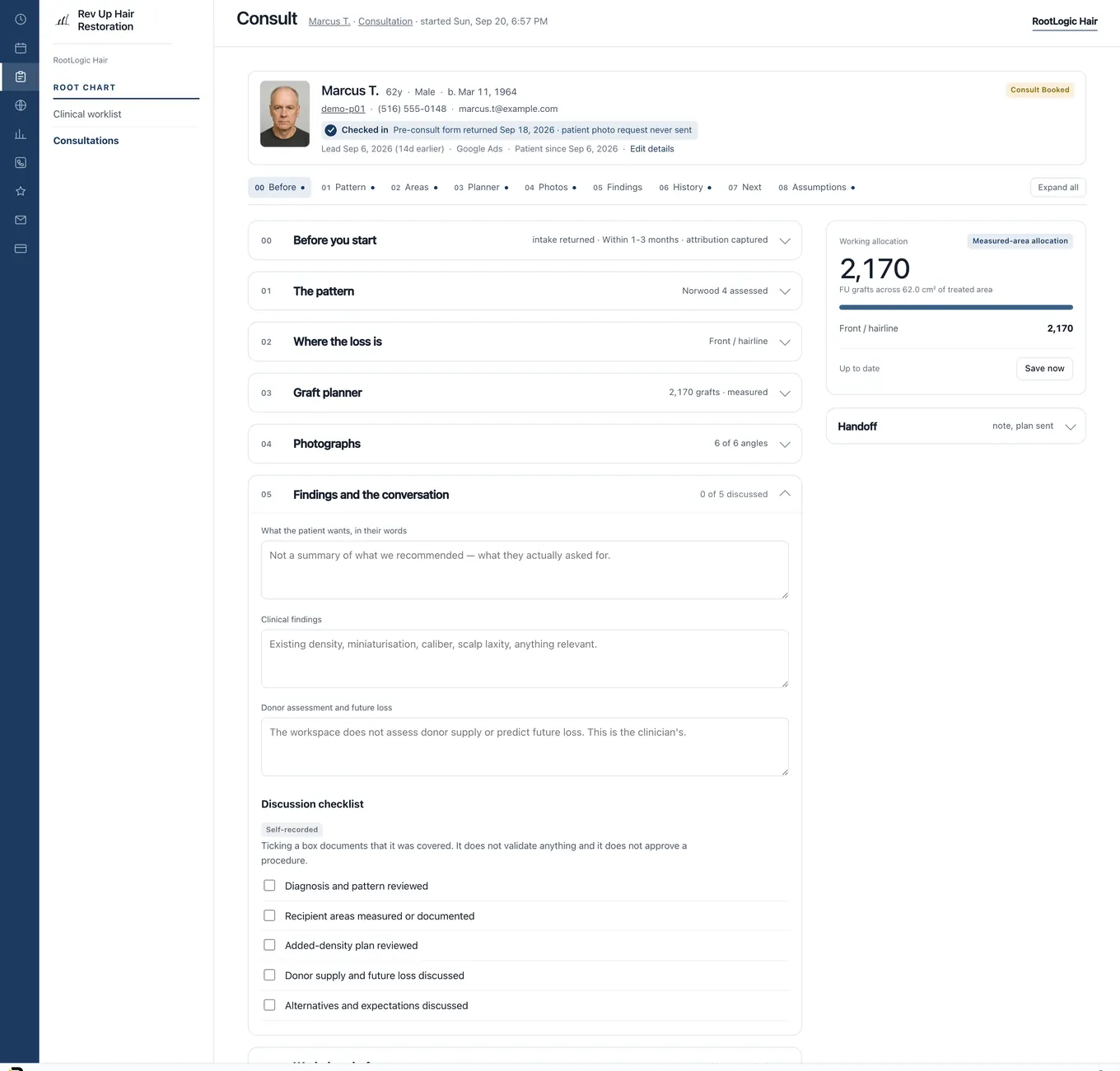
The consultation, recorded properly
Nine steps behind an anchor menu. Pattern staged on Norwood or Ludwig, with what the patient reported kept separate from what the practice assessed. Scalp regions, donor assessment, findings, and dated prior procedures, so a repair case reads as a repair case rather than a new lead with an unusual history.
A graft planner that shows its working
Regions, density and area feed a total the planner displays rather than asserts, and it withholds the total while any included region is incomplete. The counted figure is never written from an estimate: an estimate and a count are different facts, and conflating them is how an operative record stops being trustworthy.
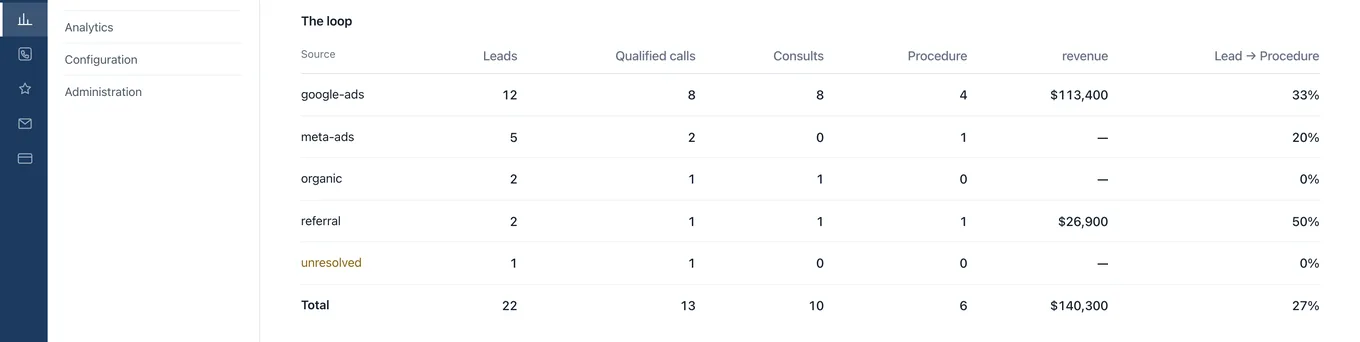
And the case lands on its source
Collected revenue attributes to the campaign that started the chain fourteen months earlier, not to the branded search the patient did the night before they called. That difference usually reorders a practice's entire view of which channels work.
The consultation workspace.
Nine steps, collapsed on load except the first incomplete one, every closed header stating what it holds.
Terms the pack actually models.
- Norwood–Hamilton
- The seven-stage male pattern scale with the A-variants. Staged in the consultation, patient-reported and practice-assessed kept apart.
- Ludwig
- The three-stage female pattern scale, modelled alongside Norwood rather than bolted on.
- Follicular unit
- The natural grouping of one to four hairs. Grafts are counted in follicular units, and graft count stays distinct from hair count.
- Safe donor area
- The occipital and parietal region assessed for supply. Donor density and laxity recorded at consultation, not estimated later.
- Recipient site
- Planned by region with its own density target, which is what makes the graft arithmetic reconstructable.
- FUE and FUT
- Extraction technique on the case, because it changes the donor plan, the recovery pathway and the photo schedule.
- Shock loss
- Temporary post-operative shedding. A documented expectation in consent and a labeled stage in the photo pathway.
- Graft yield
- The measured figure at follow-up, stored separately from the pre-operative estimate. Two fields, never one.
Where hair practices actually lose money.
Almost never the top of the funnel. Most practices in this vertical have more inquiries than they convert, and the leak is the call nobody answered well, the consultation nobody followed up, and the quote nobody chased.
We already use a general CRM. What does this add?
The clinical objects and the attribution. A general CRM has no concept of a graft allocation or a donor assessment, so all of it lives in notes and cannot be reported on.
Do we have to move our clinical records?
No. The consultation workspace, consent and imagery live here because they feed the revenue chain. Anything else stays where it is.
Can more than one surgeon use it?
Yes, and users are not metered. Each consultation carries its author, so you can see conversion by consulting surgeon.