Extensions, handsets, numbers and usage.
Each on its own page, granted by role, because a practice does not give the front desk the owner's view of the rate card.
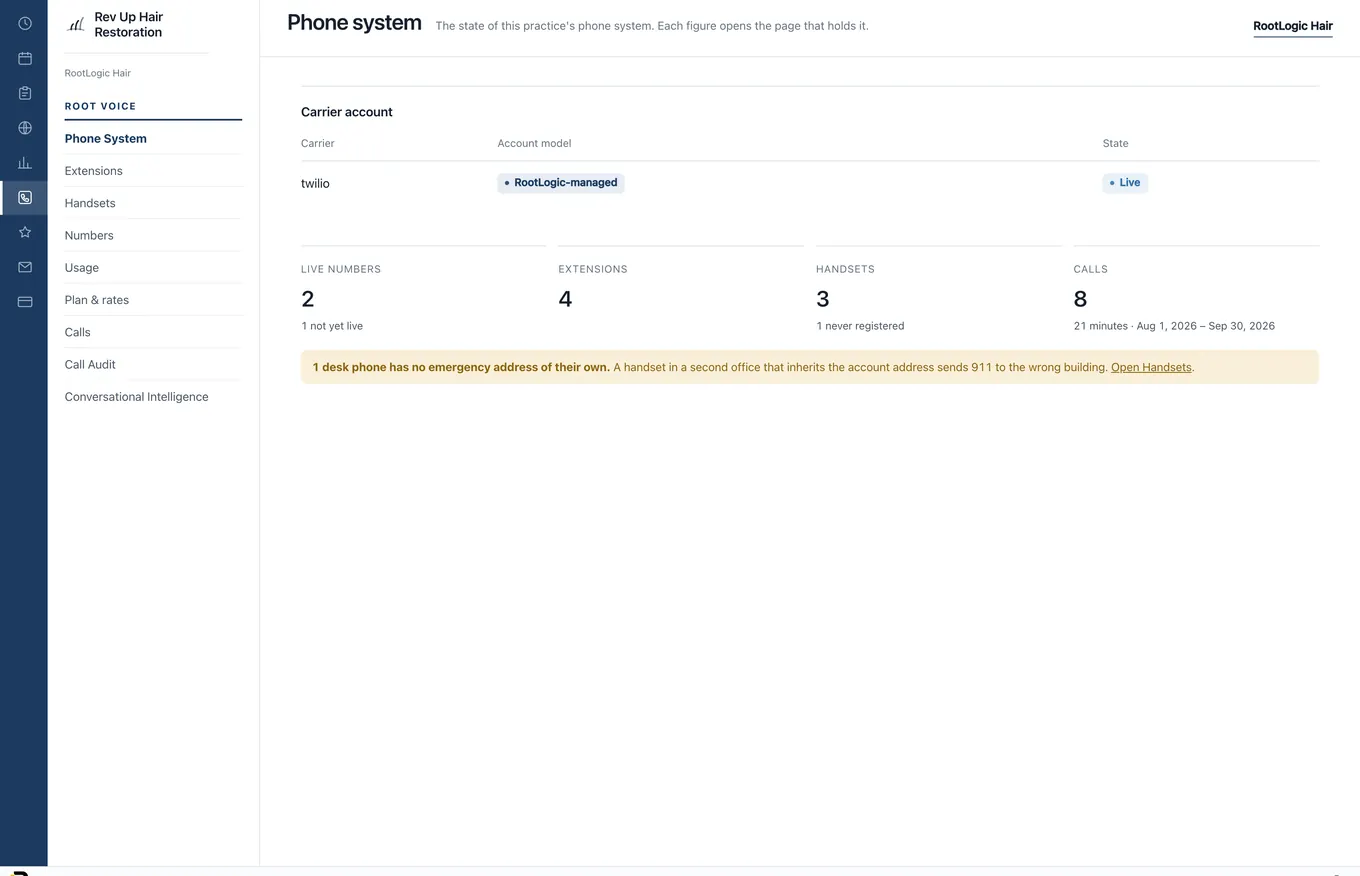
Five numbers or extensions and 2,000 talk minutes are included. Past that, usage is billed at what the carrier charges us, itemized by line, with no markup and no bundle you have to buy in advance.
Bring your own, or buy one outright.
RootVoice is a standard SIP service, so a desk phone is just a desk phone.
What registers against it
- Any SIP desk phone - Poly, Yealink, Grandstream, Cisco
- Handsets the practice already owns, rather than a drawer
- A softphone on a laptop, no hardware at all
- The mobile app, for the doctor who is never at a desk
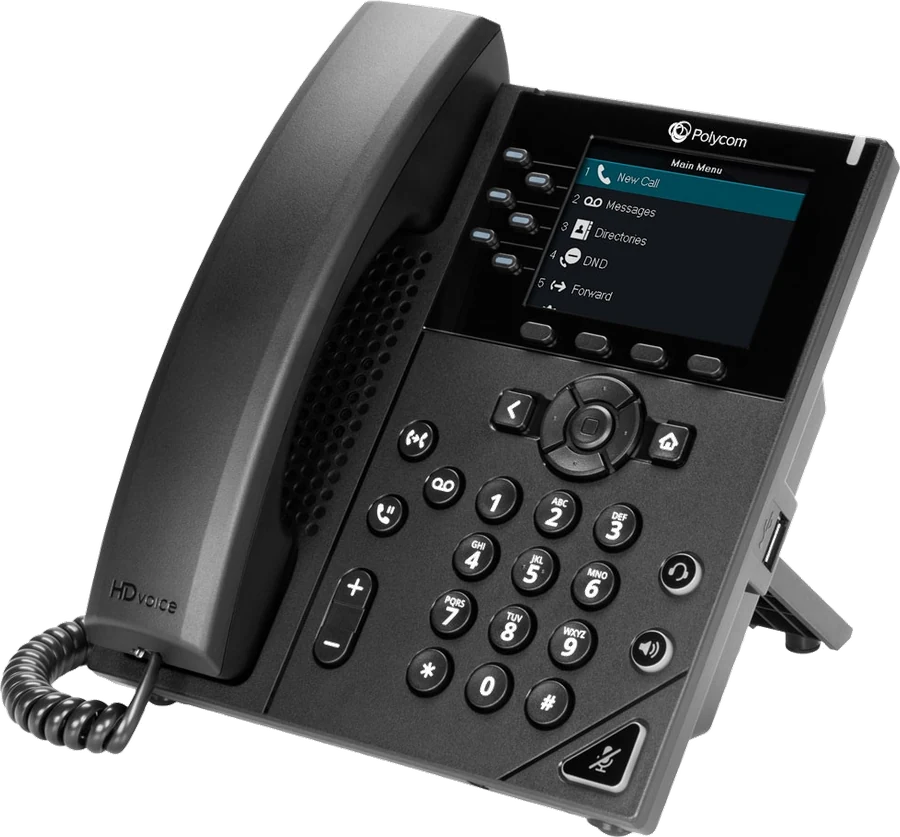
Starting from nothing, a six-line desk phone covers a front desk without anyone learning a new object. You buy it from a reseller and own it outright, the same principle as the number. We do not lease you hardware, and we do not make the phone the reason you cannot leave.
Pictured: a Poly VVX 350, six lines and a color display. One common choice among many. RootVoice does not require this model or any other.
Recorded, transcribed, and scored on what happened in it.
Not on how long it lasted. A four-minute call that books nothing and a ninety-second call that books a surgical consultation are not the same event.
The recording
Held against the patient record, not in a separate portal you log into.
The transcript
Searchable, and attached to the same case as the quote and the payment.
A qualified verdict
Was this a real inquiry. Decided by rules you can read - direction, duration, disposition - rather than a score nobody can explain.
The campaign that caused it
The click id travels with the call, so a booked consultation can be credited to the ad that produced it.
The analysis is for the next call, not the last one.
Every recorded call is analyzed, and the score carries its reasoning. A number without an explanation cannot be coached on, and a scoring system nobody can argue with is not worth having.
Lead to consultation, and consultation to procedure. Those two steps are where an elective practice makes or loses its month, and both of them happen on the phone. Reading every call rather than the handful somebody remembered is the difference between coaching the front desk and guessing at it.
What the analysis surfaces
- Whether the consultation was actually asked for, or the call just ended
- Which objections came up, and which went unanswered
- Calls that qualified and were never followed up
- Questions the caller asked that nobody on the team could answer
The qualified/not verdict stays a rules decision you can read, on the row above. This is the layer on top of it. What is in scope, and what is not.
Where it shows up
- Per staff member, so coaching has a name on it
- Per source, so a campaign producing bad calls is visible
- On the same window every other page reads
- Against the case, next to the quote and the payment
Because you will find out anyway.
Registering a handset records it. It does not provision it.
The SIP credential is minted at your carrier and its username entered here. There is no password field, because there is no column for one.
Carrier cost and margin appear on no page, at any role.
That is a product decision rather than a permission setting. Nobody in the practice sees what the call cost us, and neither does anyone on our side who does not need to.