Not a PDF filed in a folder named after the month.
A quote here is not one field. It is tracked in three registers at once: where the case sits on the board, what the financing conversation did, and what the invoice it produced is doing. Fifty open quotes with no state on them is fifty pieces of paper. Fifty quotes in states is a forecast.
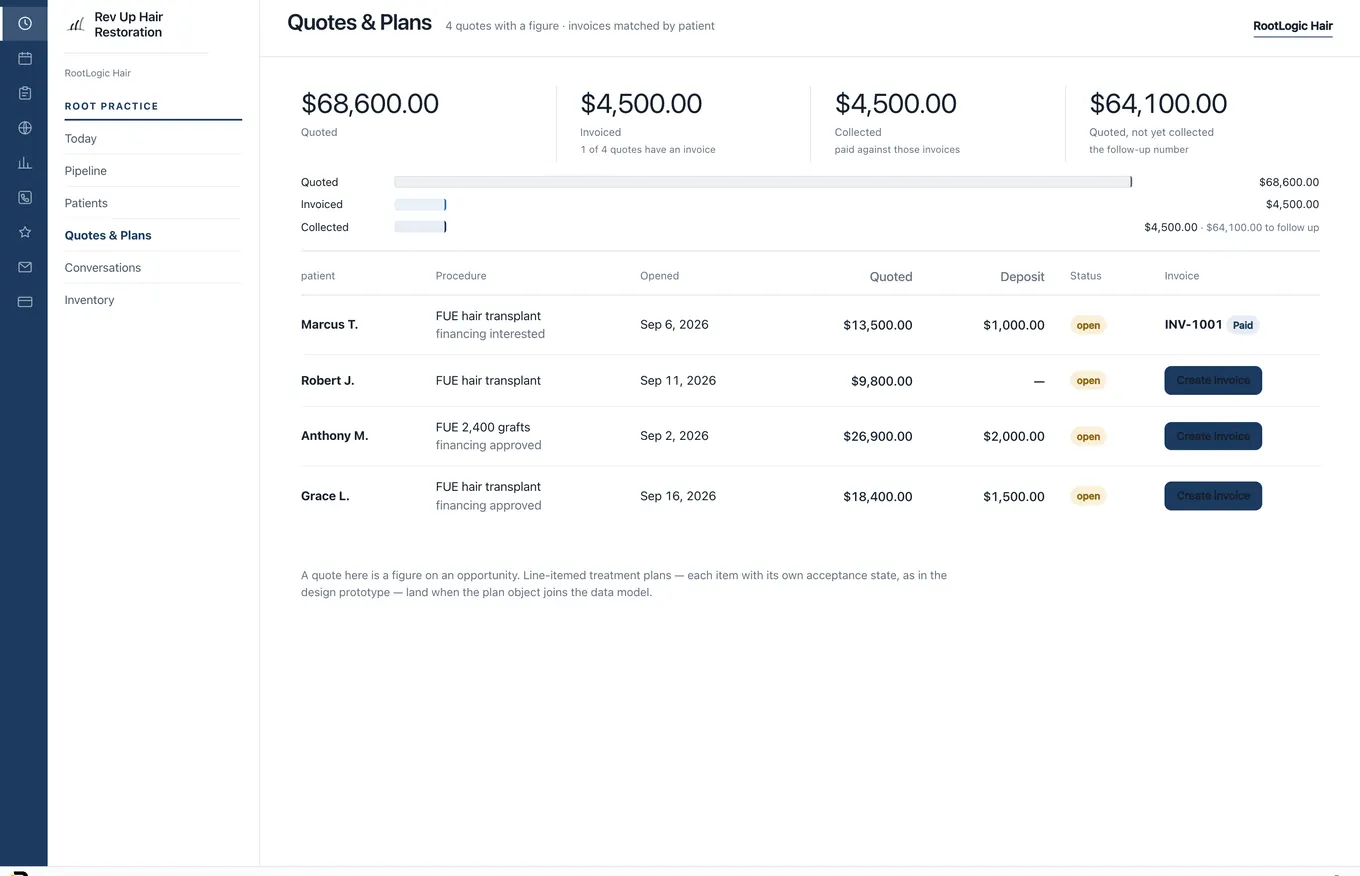
An accepted quote is already the invoice.
A quote with no invoice against it offers to create one. A quote that has been invoiced shows that invoice with its live state, read from the same balances the billing screen uses rather than restated here, so the two can never disagree.
Collected payments land on the case and on the revenue line of the campaign that produced the patient, so the ad platform learns from money rather than form fills. That path is The Loop, and the money side of it is RootPay.
All of them ordinary, all of them missing.
Case acceptance
Accepted over presented, by consulting provider. The number that most changes behavior once a practice can see it.
Time to decision
Days from presentation to acceptance, which tells you how long a follow-up sequence should actually be.
Discount leakage
Quoted against collected, per provider. Small concessions made in the room are invisible monthly and substantial annually.
Revenue at risk
Open quoted value on the board, so a slow month is visible three weeks before it closes.
All four fall out of Analytics once a quote carries a state.
The silent killer of high-ticket cases.
When an application is declined, the case stops moving and nothing records why. The practice loses a thirty-thousand-dollar case and the campaign that produced the patient still counts a conversion.
Financing is a register here rather than a conversation somebody remembers. Every case carries one of six outcomes, so the loss is a number somebody can act on instead of a gap in the pipeline.
Follow-up length set by your own numbers.
A quote carries an expiry, and the day it passes the coordinator gets an alert against that case rather than a report nobody opens. Open quotes can start a sequence in Messaging that stops the moment the patient accepts.
Time to decision tells you whether that sequence should run ten days or forty. Most practices guess. You will not have to.
The report shows who. The training covers how.
Case acceptance by provider tells you where quotes stall. Closing that gap is a different job from measuring it, so every RootLogic practice also gets a staff training library built for cash-pay medicine: how to present a quote, how to run the financing conversation, and the follow-up call most coordinators avoid.
The report shows the gap. The library gives your team the material to close it.