Ninety-four conversions, and no idea which became a patient.
A practice spends eleven thousand dollars on Google Ads. The ad account reports ninety-four conversions. The front desk remembers a busy month.
Neither system can tell you which of those ninety-four paid for anything. The ad platform's knowledge of the patient ends at the form. The practice system's begins there.
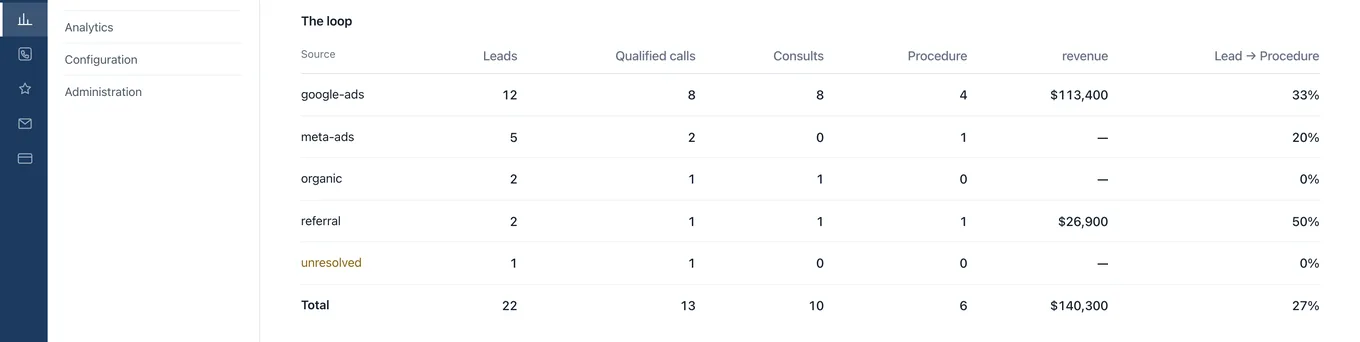
Source to revenue, on one screen.
Leads, qualified calls, consultations, procedures and collected revenue, per source. Including the sources that produced nothing, which is usually the more useful half.
Reporting looks backwards. This also steers.
Knowing which campaign produced revenue is half the value. The other half is telling the ad platform, so its bidding optimizes toward patients who pay rather than toward whoever converts most cheaply.
RootLogic sends the result back to Google and Meta. Your campaigns learn from outcomes instead of from form fills.
The category sells bolt-ons to fill this gap.
Not one platform serving elective medicine closes this natively, and not one names the return leg anywhere in its product. There is a small industry of add-on tools that exist only to bridge it.
The reason is structural. A system that began as an electronic record treats marketing as a module at the edge. Closing the loop means owning the phone, the lead, the consultation, the quote and the payment from day one.
The click that produced a twelve thousand dollar case and the click that produced nothing look identical to every other system in the building.
The gap RootLogic was built to close
The ones that come up on every call.
What if a patient calls instead of filling in a form?
That is the normal case in elective medicine, and it is why the phone line is part of the product rather than a partner integration. A call is attributed as precisely as a form fill.
What about a patient who took four months and six touches?
Attribution is to the source that started it, not the last thing clicked. Long consideration windows are the norm here, and last-click reporting systematically misprices them.
Does this replace Google Analytics?
No. Analytics tells you what happened on the website. RootLogic tells you what happened to the person afterwards.
What if we do not run ads?
The same reporting covers referrals, organic and walk-ins. Practices that do not advertise still want to know which referral relationship is carrying the month.